

The Mazda CX-5 and CX-30 share a design language and a platform philosophy, but choosing between them comes down to one practical question: how much space do you actually use on a typical Oʻahu drive? Both SUVs are built around the same Kodo design principles and deliver the same driver-focused character. However, they occupy different size classes, and those classes carry real differences in interior volume, cargo geometry, and how each model moves through city streets and tight parking structures. Understanding what separates them helps shoppers avoid choosing more vehicle than they need, or less than they expected.
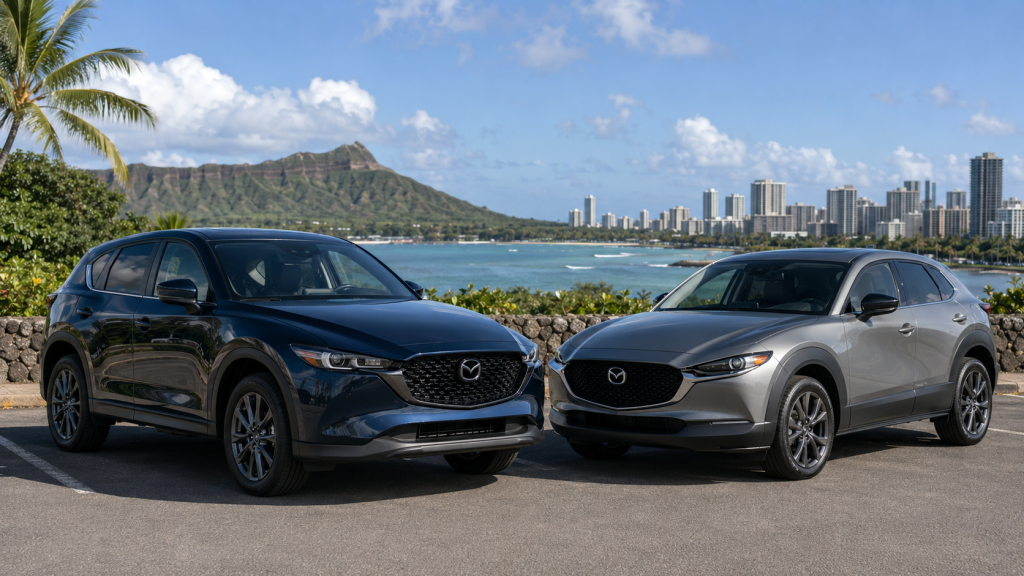
How Much Bigger Is the CX-5 Compared to the CX-30?
The CX-5 is a compact SUV. The CX-30 is a subcompact crossover. Those labels are not marketing categories. They reflect EPA vehicle classification standards based on interior passenger and cargo volume. The CX-5 clears the threshold for compact SUV classification because its combined interior volume is large enough to qualify. The CX-30 falls below that threshold, which places it in the subcompact crossover category alongside smaller alternatives from other brands.
In practical terms, the CX-5 is approximately 6.5 inches longer overall than the CX-30. It also sits about 4.4 inches taller. The wheelbase, which is the distance between the front and rear axles, is roughly 4 inches longer on the CX-5. Each of those measurements has downstream effects on interior space, cargo capacity, and how the vehicle behaves in confined areas. The CX-5 is wider as well, which affects both shoulder room inside the cabin and the width of the footprint the driver manages in parking garages and narrow lanes. For shoppers who have not sat in both vehicles, the size difference is more noticeable than the numbers suggest.
Neither model offers a third row. Both are strictly two-row vehicles. The decision between them is not about seating count. It is about how much room each row provides and how much cargo volume sits behind it.
Cargo Space and What the Numbers Actually Tell You
The CX-5 offers approximately 30.9 cubic feet of cargo space behind the rear seats. The CX-30 provides approximately 20.2 cubic feet in the same configuration. That is a difference of roughly 10 cubic feet, which sounds significant in isolation. However, raw cubic footage does not fully describe the usable space inside either model. The shape of the cargo floor, the width of the load opening, and the slope from the rear seatback to the cargo floor all affect what a driver can realistically load and unload. The following points describe the cargo geometry difference between the two models:
- The CX-5 has a wider cargo opening and a flatter load floor behind the rear seats. Larger, flat items such as surfboard bags, coolers, or stroller frames load more easily because the floor does not slope sharply and the opening does not narrow quickly toward the center.
- The CX-30’s cargo floor is narrower and sits at a slightly different angle relative to the rear seat. It suits smaller, more frequent loads well, including grocery bags, backpacks, and beach gear for two people. It becomes limiting when the load is wide, long, or requires a flat surface.
- With rear seats folded flat, the CX-5 expands to approximately 59.3 cubic feet of total cargo volume. The CX-30 reaches approximately 45.1 cubic feet. For buyers who carry large items occasionally, that folded-flat difference is the more meaningful comparison point.
Rear Seat Comfort and How the Roofline Affects Passengers
The CX-5’s taller overall height translates directly into rear seat headroom. Adult passengers sitting in the second row of the CX-5 have more clearance above their heads than they do in the CX-30. The CX-30’s lower roofline compresses the interior height in the rear seating area, which affects taller passengers most noticeably. Rear legroom is comparable between models, so the primary comfort variable in the back seat is vertical clearance, not fore-and-aft space.
For families with children in car seats, the CX-30 handles the task without issue. Children in forward-facing or rear-facing seats do not require the same headroom that adult passengers do, and the CX-30’s rear seat width accommodates standard car seat bases comfortably. The distinction becomes relevant when the rear passengers are adults riding any meaningful distance. For regular Oʻahu commutes with adult rear passengers, the CX-5’s additional headroom makes the back seat noticeably more comfortable over time.
Front seat space is generous in both models. Mazda’s seat design in both the CX-5 and CX-30 prioritizes lateral support and long-distance comfort, and neither cabin feels cramped in the first row. The difference in interior experience is concentrated in the rear, and that difference is driven almost entirely by the roofline height gap between the two platforms.
How Each Model Handles Urban Driving and Tight Spaces
A shorter wheelbase reduces the turning radius. The CX-30’s wheelbase advantage over the CX-5 translates into a tighter turning circle, which matters in multi-level parking garages, narrow residential streets, and the kind of dense urban grid found in downtown Honolulu. Drivers who navigate tight spaces frequently will notice the difference in low-speed maneuverability. The CX-30 changes direction more quickly at parking lot speeds and requires less forward-backward correction when backing into stalls. The following points connect the dimensional differences to daily urban driving:
- The CX-30’s shorter overall length makes parallel parking and angled stall parking more straightforward in compact urban spaces. A vehicle that is 6.5 inches shorter occupies meaningfully less linear space in a stall and gives the driver more margin in tight entry and exit situations.
- The CX-5’s wider track and longer wheelbase give it more planted, stable highway behavior. On longer drives across the island or during highway sections of the H-1, the CX-5 feels more settled at speed. The additional weight and width work in its favor at sustained freeway pace.
Which Mazda SUV Fits Oʻahu Roads More Naturally?
Oʻahu’s driving environment rewards right-sized vehicles. Parking in Kakaʻako, navigating the streets near the University of Hawaiʻi, or finding a stall at a beach access point puts a premium on a compact footprint. At the same time, many Oʻahu families use their SUV for weekend beach trips, trail access, and occasional hauls that benefit from a larger cargo area. The right answer depends on which of those use cases shows up more often.
For solo drivers, couples, or small families who spend most of their time in Honolulu’s urban core, the CX-30 is a better fit. It is easier to park, nimbler at low speeds, and provides enough cargo room for the grocery runs, beach days, and weekend errands that define most daily routines on the island. For families who regularly carry three or four adults, haul larger gear, or want rear seat comfort for longer drives across the island, the CX-5 justifies its larger footprint. Both models are available at Cutter Honolulu Mazda, and sitting in each one back to back is the clearest way to understand where the size difference actually shows up for your specific daily pattern.
Connect with us


- July 2026
- June 2026
- May 2026
- April 2026
- May 2024
- March 2024
- February 2024
- December 2023
- November 2023
- October 2023
- September 2023
- August 2023
- July 2023
- June 2023
- May 2023
- April 2023
- March 2023
- February 2023
- January 2023
- December 2022
- November 2022
- October 2022
- September 2022
- August 2022
- July 2022
- June 2022
- May 2022
- April 2022
- March 2022
- February 2022
- January 2022