

Mazda3 Hatchback daily driving in Honolulu can combine compact dimensions, adaptable cargo access, and responsive road manners. In addition, that mix matters when your week includes commuting, errands, passengers, and tight parking. Furthermore, the five door shape gives you a wide rear opening without moving into a taller crossover. Because the cabin sits lower, the car also keeps a close connection to the road. Therefore, the key question is not whether a hatchback can do everything. It is whether its size and layout fit the way you move through Honolulu.
Why the Hatchback Body Shape Changes Cargo Access
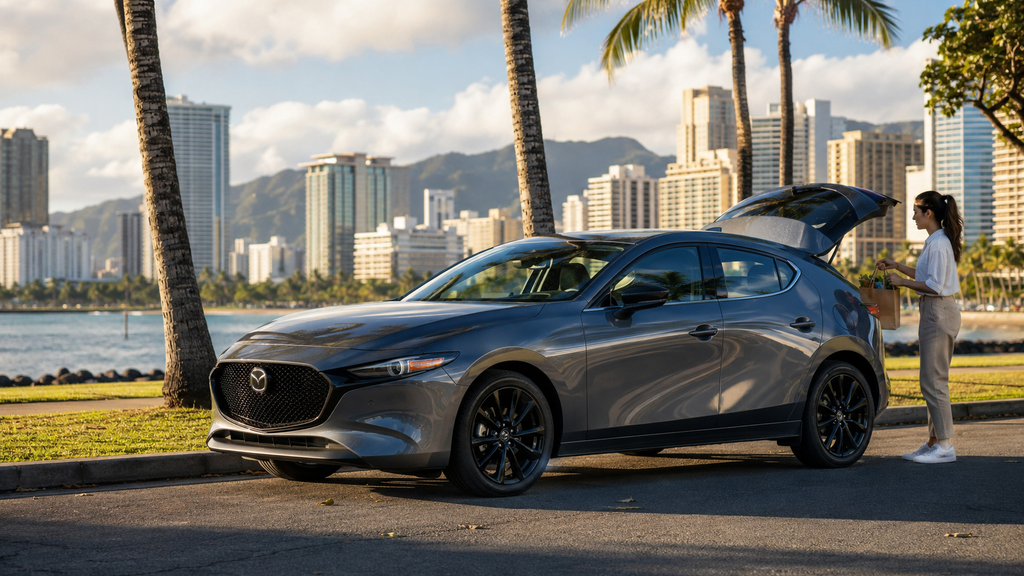
A hatchback uses a rear door that lifts with the glass. That creates a taller opening than a conventional trunk lid. Because the opening extends upward, boxes and bulky items can pass through with fewer angle changes. In addition, the cargo floor sits close to the opening, which makes loading feel direct.
How does that shape change Mazda3 Hatchback daily driving during a normal errand? Think about grocery bags, beach chairs, folded strollers, small coolers, or luggage. However, these items may fit within the published cargo volume, yet opening shape still controls how easily they enter. Therefore, the hatch itself deserves attention during a showroom visit.
The rear seatbacks add another layer of choice. Mazda uses a split folding design, so you can lower one side while leaving seating on the other. That can work well when one rear passenger rides with a longer item. In addition, the wider opening makes it easier to slide that item into place.
With that in mind, bring your routine into the evaluation before deciding that cargo space is enough. Consider what you carry most weeks, instead of rare large loads. A hatchback can feel roomy for one household and tight for another. The shape of your gear matters just as much as the published volume.
Is the Mazda3 Hatchback Easy to Park in Honolulu?
Its compact length and turning diameter support tighter low speed maneuvering. The Mazda3 Hatchback measures 175.6 inches long, which keeps the body relatively short for a five door car. That footprint can be useful in crowded lots, neighborhood streets, and parking structures around Honolulu.
Mazda3 Hatchback daily driving also involves how clearly you can judge the car’s corners. The low hood and compact body make the front end easier to place. However, the rear pillars are broad, so rearward sightlines deserve a careful test. A backup camera can support that view, but you should still check mirrors and shoulder visibility.
What should you test during a parking maneuver? Start with a normal space, then try a tighter one. Notice how much steering input you need and how quickly the car pivots. In addition, check whether the rear glass gives you enough visual context when reversing.
In addition, the hatchback’s lower height changes how you perceive nearby vehicles. You sit closer to sedan height than crossover height. Because of that seating position, sightlines may feel different if you are used to an SUV. A short test drive can tell you whether that view feels natural.
How Much Can the Mazda3 Hatchback Carry?
Cargo fit comes from both available volume and the shape of the rear opening. The Mazda3 Hatchback provides 20.1 cubic feet behind the rear seats. With the rear seat folded, published measurements reach 47.1 cubic feet. However, those numbers give useful scale, but they do not describe every loading situation.
Mazda3 Hatchback daily driving can include mixed passenger and cargo needs. A split rear seat lets you adjust the cabin around the load. Before lowering both sides, consider whether only one section is needed. That preserves seating for a passenger while opening more length for gear.
A few loading checks can make the decision easier:
- Place a medium suitcase or storage bin near the hatch opening. This shows whether the opening height works with your common items.
- Fold one rear seat section and check the floor transition. This shows how longer items will sit across the rear area.
- Sit in the remaining rear seat after folding the other side. This confirms whether passenger room still works for your routine.
Because the hatch opening is part of the rear body, loading also changes how you use curbside space. You need room behind the car for the hatch to rise. Therefore, a tight wall or another parked car can limit access even when the cargo area itself is large enough.
How Mazda Driving Traits Fit Honolulu Roads
The Mazda3 Hatchback uses G Vectoring Control Plus to make small adjustments during steering input. The goal is smoother weight transfer as the car turns. You may notice that as a more settled path through curves and lane changes. The correction works in the background, so the steering can feel natural instead of busy.
How does Mazda3 Hatchback daily driving feel during a normal commute? Honolulu roads can combine stop and go traffic, short merges, and frequent turns. A compact car with clear steering feedback can make lane placement easier. In addition, the lower body gives the Mazda3 Hatchback a connected feel through corners.
By contrast, the available 2.5 Turbo changes acceleration more than the basic shape of the car. Its stronger low rpm torque can make merging and passing feel quicker. That matters when you need speed without holding the throttle open for long. The turbo model also pairs with i Activ AWD, which monitors wheel speed and other inputs while distributing power.
Shoppers should decide whether they value that stronger response enough to choose the turbo trim. The standard engine may already suit calmer commuting. Therefore, the test drive should include the same roads you use each week. Try a merge, a hill, a slow turn, and a short passing zone if possible.
What to Evaluate During a Mazda3 Hatchback Test Drive
Mazda3 Hatchback daily driving should feel natural before you commit. A useful test drive should copy your normal routine as closely as possible. Do not judge the Mazda3 Hatchback from one straight road. Include parking, a tighter turn, moderate traffic, and a short highway section if available. That gives you a clearer view of how the car fits daily travel.
Start with seating position and visibility. Adjust the seat and mirrors before moving. Then check the rear pillars during shoulder checks and reversing. If rear sightlines feel limited, see whether the mirrors and camera give you enough information.
Next, test the cargo area with the kind of items you carry. You do not need a full trunk load. One suitcase, stroller, cooler, or storage bin can reveal a lot about opening size and floor height.
You can also use a short checklist during the drive:
- Check whether the steering feels easy to place in narrow lanes and parking areas. Pay attention to how quickly the car responds.
- Sit in the rear seat after setting the front seat for yourself. This gives you a more realistic view of passenger room.
- Open the hatch in a normal parking space. Confirm that you have enough room behind the car to load comfortably.
Mazda3 Hatchback daily driving in Honolulu works best when the car matches your routine, not an abstract category. The compact footprint, hatch opening, rear seat layout, and road feel each answer a different need. Spend time with those details before deciding. When the fit is right, the hatchback can handle a wide mix of city trips without feeling oversized.
Connect with us


- August 2026
- July 2026
- June 2026
- May 2026
- April 2026
- May 2024
- March 2024
- February 2024
- December 2023
- November 2023
- October 2023
- September 2023
- August 2023
- July 2023
- June 2023
- May 2023
- April 2023
- March 2023
- February 2023
- January 2023
- December 2022
- November 2022
- October 2022
- September 2022
- August 2022
- July 2022
- June 2022
- May 2022
- April 2022
- March 2022
- February 2022
- January 2022