Blog / Honolulu Mazda Dealer

MX-5 Miata vs MX-5 Miata RF: Convertible Differences Explained

Choosing between the MX-5 Miata and MX-5 Miata RF starts with one structural question: how much of the sky do you actually want overhead? Both models share the same chassis, the same 2.0-liter naturally aspirated engine, and the same rear-wheel drive layout. However, the roof separates them in ways that go beyond a folding panel. The mechanism changes the car's weight, its structural geometry, its sound environment, and its visual identity. For shoppers in Honolulu evaluating a Mazda sports car, understanding those differences clearly makes the decision much easier. 

What Does RF Mean, and How Does the Roof Actually Work? 

RF stands for Retractable Fastback. That name describes two things at once: the retractable roof panel and the fastback roofline it creates when closed. The MX-5 RF is not a traditional convertible, and it is not a targa top. It is a distinct roof format with its own mechanical logic. 

When the RF roof opens, three things happen in sequence. The rear deck panel lifts, the glass rear window retracts into the body, and the center roof panel folds into the compartment behind the seats. The result is an open cockpit with two fixed rear buttresses framing the driver and passenger. Those buttresses stay in place whether the roof is open or closed. They are structural elements, not styling choices. Because they remain fixed, the opening the RF creates is smaller than what the soft top produces. The soft top folds completely behind the seats and disappears, leaving a fully open profile above and behind the occupants. 

On the standard MX-5 Miata, the soft top is manually operated. The driver reaches back, unlatches the header, and folds the fabric rearward in a single motion. The entire process takes a few seconds. The RF roof is power-operated and requires the car to be stationary or moving below a low speed threshold. The folding sequence takes approximately 13 seconds to complete. That distinction matters in everyday use. The soft top can go down at a traffic light. The RF requires a deliberate stop. 

Structural Differences and the Weight Conversation 

The RF roof assembly adds weight to the MX-5 platform, and that weight comes from two sources. The folding hardtop panel itself is heavier than a fabric soft top by a meaningful margin. Beyond that, the chassis requires additional reinforcement to manage the structural demands of a retractable hardtop mechanism. The soft top MX-5 Miata does not need that reinforcement because the fabric top adds minimal structural load. The RF adds approximately 90 pounds to the overall curb weight, concentrated in the rear of the car. 

For a sports car that weighs under 2,500 pounds in soft top form, 90 additional pounds in the tail has a measurable effect. The RF requires a small adjustment in driving style, especially at corner entry. The rear feels slightly heavier before rotation begins, which means the car responds differently to trail braking. Mazda engineers tuned the RF's suspension geometry to account for the added rear mass, so the car remains balanced. Still, enthusiasts who prioritize the lightest possible setup will find the soft top more responsive at the limit. Here is what the weight difference means at the specification level: 

  • The soft top MX-5 Miata weighs approximately 2,341 pounds in Sport trim. The RF in the same trim weighs approximately 2,427 pounds, a difference of roughly 86 to 90 pounds depending on configuration. 
  • The added weight sits primarily above and behind the rear axle, which raises the car's polar moment of inertia. This affects how quickly the rear rotates in response to steering input on corner entry. 
  • Mazda retuned the RF's rear spring rates and damper settings relative to the soft top to compensate. The RF does not feel unbalanced, but it does feel subtly more composed and slightly less immediate than its lighter counterpart. 

How Each Roof Format Shapes the Driving Environment 

Sound and airflow inside an open sports car are not random. They follow the geometry of the car. In the soft top MX-5 Miata with the top down, airflow moves across the windshield, over the cockpit, and exits behind the seats without obstruction. At highway speed, turbulence enters from behind the driver's head because there is nothing to redirect it. This creates the buffeting sensation that many convertible drivers recognize on faster roads. The sensation is manageable at city speeds and on back roads, but it becomes more pronounced as speed increases. 

The RF's fixed rear buttresses change that dynamic. By framing the open cockpit with fixed rear quarter sections, the RF redirects airflow around the occupants rather than through the opening behind them. The result is a noticeably calmer interior environment at speed. Wind still moves through the cabin, but the buffeting that enters from the rear is significantly reduced. For buyers who plan to use the car regularly on the H-1 or on longer coastal drives, that difference in wind management is real and worth evaluating. The following points summarize the sound environment contrast: 

  • The soft top MX-5 Miata with the top down is louder at freeway speed. The open rear profile allows turbulence to enter from behind the driver, creating pronounced buffeting above 60 mph. 
  • The RF, with its roof open, maintains a calmer cockpit because the fixed rear buttresses contain the airflow envelope around the seating area. Conversations at freeway speed are easier in the RF. 
  • With the top closed, the RF has a quieter cabin than the soft top MX-5. The hardtop panel provides better insulation from road and wind noise than the fabric layer, which benefits drivers in rain or on longer trips. 

Visual Character and What the Roofline Communicates 

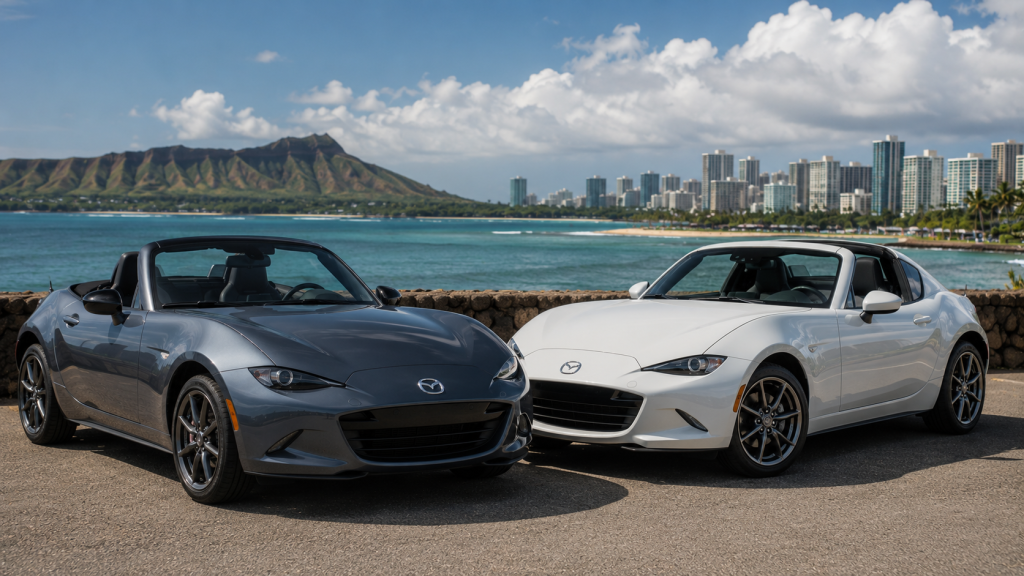
The MX-5 RF has a fastback silhouette when the roof is closed. The roofline flows from the windshield header rearward in a smooth arc before dropping toward the tail. That shape gives the RF a coupe-like appearance that the soft top does not have. The soft top MX-5 Miata has a more traditional roadster profile, with a fabric roof that sits higher at the header and tapers toward the rear. When both cars are parked side by side with their tops up, they look like different vehicles despite sharing the same wheelbase and front fascia. 

With both roofs open, the difference shifts to what remains. The soft top disappears almost entirely. The RF retains its rear buttresses, giving the open car a more structured appearance. Some buyers prefer the cleaner, more open look of the soft top with the roof down. Others prefer the more sculpted, architectural profile the RF presents. Neither is objectively correct. However, the RF's roofline communicates something the soft top does not: a coupe-derived identity that feels deliberate in its character. For buyers who spend time with the roof closed as often as open, that distinction shapes how the car reads in parking lots and on the road. 

Which MX-5 Makes More Sense for How You Drive in Honolulu? 

Honolulu driving conditions favor the MX-5 format in a way that few other markets can match. The weather supports open-top driving year-round. The salt air and trade winds make the experience distinct. The lower freeway speeds on the H-1 keep the soft top's wind management limitations less significant than they would be at mainland highway speeds. Given all of that, both configurations make genuine sense here. The choice comes down to how you weigh four things: roof operation simplicity, weight and driving feel, interior comfort at speed, and visual identity. 

The soft top MX-5 Miata is the lighter, simpler, and more immediate car. It goes down in seconds, adds no mechanical complexity, and gives the driver the most unobstructed open-air experience available. For buyers who want the purest expression of the MX-5 formula, the soft top is the right answer. The RF is the right choice for buyers who spend time at highway speed, value a quieter closed cabin on wet days, or want the fastback silhouette. The RF does not compromise the MX-5's core character. It reshapes it. At Cutter Honolulu Mazda, both configurations are available to experience in person, which is the most reliable way to understand which one fits your daily drive. 
Posted in:

Related Posts

mazda3 hatchback daily driving

Mazda3 Hatchback Daily Driving in Honolulu Made Simple

Mazda3 Hatchback daily driving in Honolulu can combine compact dimensions, adaptable cargo access, and responsive road manners. In addition, that mix matters when your week includes commuting, errands, passengers, and tight parking. Furthermore, the five door shape gives you a wide rear opening without moving into a taller crossover. Because the cabin sits lower, the car also keeps a close connection to the road. Therefore, the key question is not whether a hatchback can do everything. It is whether its size and layout fit the way you move through Honolulu. Why the Hatchback Body Shape Changes Cargo Access A hatchback uses a rear door that lifts with the glass. That creates a taller opening than a conventional trunk lid. Because the opening extends upward, boxes and bulky items can pass through with fewer angle changes. In addition, the cargo floor sits close to the opening, which makes loading feel direct. How does that shape change Mazda3 Hatchback daily driving during a normal errand? Think about grocery bags, beach chairs, folded strollers, small coolers, or luggage. However, these items may fit within the published cargo volume, yet opening shape still controls how easily they enter. Therefore, the hatch itself deserves attention during a showroom visit. more The rear seatbacks add another layer of choice. Mazda uses a split folding design, so you can lower one side while leaving seating on the other. That can work well when one rear passenger rides with a longer item. In addition, the wider opening makes it easier to slide that item into place. With that in mind, bring your routine into the evaluation before deciding that cargo space is enough. Consider what you carry most weeks, instead of rare large loads. A hatchback can feel roomy for one household and tight for another. The shape of your gear matters just as much as the published volume. Is the Mazda3 Hatchback Easy to Park in Honolulu? Its compact length and turning diameter support tighter low speed maneuvering. The Mazda3 Hatchback measures 175.6 inches long, which keeps the body relatively short for a five door car. That footprint can be useful in crowded lots, neighborhood streets, and parking structures around Honolulu. Mazda3 Hatchback daily driving also involves how clearly you can judge the car's corners. The low hood and compact body make the front end easier to place. However, the rear pillars are broad, so rearward sightlines deserve a careful test. A backup camera can support that view, but you should still check mirrors and shoulder visibility. What should you test during a parking maneuver? Start with a normal space, then try a tighter one. Notice how much steering input you need and how quickly the car pivots. In addition, check whether the rear glass gives you enough visual context when reversing. In addition, the hatchback's lower height changes how you perceive nearby vehicles. You sit closer to sedan height than crossover height. Because of that seating position, sightlines may feel different if you are used to an SUV. A short test drive can tell you whether that view feels natural. How Much Can the Mazda3 Hatchback Carry? Cargo fit comes from both available volume and the shape of the rear opening. The Mazda3 Hatchback provides 20.1 cubic feet behind the rear seats. With the rear seat folded, published measurements reach 47.1 cubic feet. However, those numbers give useful scale, but they do not describe every loading situation. Mazda3 Hatchback daily driving can include mixed passenger and cargo needs. A split rear seat lets you adjust the cabin around the load. Before lowering both sides, consider whether only one section is needed. That preserves seating for a passenger while opening more length for gear. A few loading checks can make the decision easier: Place a medium suitcase or storage bin near the hatch opening. This shows whether the opening height works with your common items. Fold one rear seat section and check the floor transition. This shows how longer items will sit across the rear area. Sit in the remaining rear seat after folding the other side. This confirms whether passenger room still works for your routine. Because the hatch opening is part of the rear body, loading also changes how you use curbside space. You need room behind the car for the hatch to rise. Therefore, a tight wall or another parked car can limit access even when the cargo area itself is large enough. How Mazda Driving Traits Fit Honolulu Roads The Mazda3 Hatchback uses G Vectoring Control Plus to make small adjustments during steering input. The goal is smoother weight transfer as the car turns. You may notice that as a more settled path through curves and lane changes. The correction works in the background, so the steering can feel natural instead of busy. How does Mazda3 Hatchback daily driving feel during a normal commute? Honolulu roads can combine stop and go traffic, short merges, and frequent turns. A compact car with clear steering feedback can make lane placement easier. In addition, the lower body gives the Mazda3 Hatchback a connected feel through corners. By contrast, the available 2.5 Turbo changes acceleration more than the basic shape of the car. Its stronger low rpm torque can make merging and passing feel quicker. That matters when you need speed without holding the throttle open for long. The turbo model also pairs with i Activ AWD, which monitors wheel speed and other inputs while distributing power. Shoppers should decide whether they value that stronger response enough to choose the turbo trim. The standard engine may already suit calmer commuting. Therefore, the test drive should include the same roads you use each week. Try a merge, a hill, a slow turn, and a short passing zone if possible. What to Evaluate During a Mazda3 Hatchback Test Drive Mazda3 Hatchback daily driving should feel natural before you commit. A useful test drive should copy your normal routine as closely as possible. Do not judge the Mazda3 Hatchback from one straight road. Include parking, a tighter turn, moderate traffic, and a short highway section if available. That gives you a clearer view of how the car fits daily travel. Start with seating position and visibility. Adjust the seat and mirrors before moving. Then check the rear pillars during shoulder checks and reversing. If rear sightlines feel limited, see whether the mirrors and camera give you enough information. Next, test the cargo area with the kind of items you carry. You do not need a full trunk load. One suitcase, stroller, cooler, or storage bin can reveal a lot about opening size and floor height. You can also use a short checklist during the drive: Check whether the steering feels easy to place in narrow lanes and parking areas. Pay attention to how quickly the car responds. Sit in the rear seat after setting the front seat for yourself. This gives you a more realistic view of passenger room. Open the hatch in a normal parking space. Confirm that you have enough room behind the car to load comfortably. Mazda3 Hatchback daily driving in Honolulu works best when the car matches your routine, not an abstract category. The compact footprint, hatch opening, rear seat layout, and road feel each answer a different need. Spend time with those details before deciding. When the fit is right, the hatchback can handle a wide mix of city trips without feeling oversized.

Mazda CX-30 Daily Driving Guide for Honolulu Roads

Mazda CX-30 daily driving starts with parking, seating, visibility, passenger space, and cargo needs. Honolulu roads can include tight garages, busy lanes, steep streets, and short trips. Therefore, each detail deserves a closer look before choosing this compact crossover. The CX-30 measures 173 inches long and 70.7 inches wide. Those dimensions place it between a small hatchback and a larger SUV. Because size shapes every trip, drivers should test the CX-30 where they park and travel most. Compact Size for Honolulu Parking Exterior size shapes how easily a vehicle moves through garages, narrow lanes, and crowded parking areas. The CX-30 uses a compact footprint that can suit many Honolulu routes. Its 173 inch length leaves less body behind the rear axle than larger SUVs. Therefore, the rear end follows more closely during slow turns. That trait can make tight parking moves easier to judge. more Width matters when spaces sit close together. The CX-30 measures 70.7 inches wide without mirrors. In addition, its doors still need enough room for passengers to enter comfortably. Before deciding, test these parking tasks: Enter a space between two vehicles and check door clearance on both sides. Reverse from a busy row while watching mirrors, windows, and dashboard alerts. Turn through a garage ramp and note how closely each wheel tracks the curb. Mazda CX-30 daily driving can feel easier when low speed steering supports careful placement. Still, drivers should not rely on steering feel alone. Mirror setup and seat position remain just as important. Comfort During Repeated Honolulu Trips Mazda CX-30 daily driving comfort begins with the driver’s seat, pedal reach, and steering wheel position. The CX-30 places major controls within easy reach from the front seats. First, adjust the seat before judging cabin space. Your hips should remain supported while your knees stay slightly bent. Then adjust the wheel so both hands rest comfortably without leaning forward. The front seats use firm cushioning and shaped side support. Therefore, posture may feel more secure during frequent turns. That firmness may also feel different from softer seating in other crossovers. Honolulu trips may involve short drives with repeated stops. Because of that pattern, easy entry and quick control access matter. Drivers should test the seat after several exits and returns. Climate control placement also deserves attention. The CX-30 uses physical controls for key cabin settings. Furthermore, the center display sits high on the dashboard for easier viewing. A calm cabin layout can reduce distraction during crowded travel. Even so, every driver should test the controls while parked. Familiarity matters before traffic begins moving. Visibility Around Traffic and Parking Areas Mazda CX-30 daily driving visibility covers what you see through the glass, mirrors, and available camera views. The CX-30 provides a raised seating position than a low car. Forward sightlines feel open from a properly adjusted seat. However, the rear roofline and rear pillars can narrow the view behind the vehicle. Therefore, drivers should test every viewing angle. Blind Spot Monitoring and Rear Cross Traffic Alert support side and rear awareness. These features can warn about nearby traffic that enters a monitored area. Still, direct mirror and shoulder checks remain necessary. Some trims add parking sensors or a 360 degree monitor. Those tools can support low speed spacing around curbs and nearby vehicles. Because equipment varies, confirm the exact trim before purchase. During a test drive, check these views: Look over each shoulder while parked and note how much glass remains visible. Reverse into a space and compare the camera image with your mirror view. Change lanes safely and observe when the blind spot alert appears. Bright sun and heavy rain can change what cameras and mirrors show. Therefore, drivers should keep lenses and glass clean. Clear surfaces support better awareness during repeated trips. Passenger Space Behind the Front Seats Mazda CX-30 daily driving fit also depends on rear seat space and passenger height. The CX-30 can carry five people, but the rear row suits some groups better. Set the front seat for the regular driver first. Then sit behind that position and check knee, foot, and head room. This step gives a more useful answer than published measurements alone. Adults with longer legs may find the rear row tighter. By contrast, children or shorter adults may fit comfortably for local trips. The result depends on who rides there most. Child seats require another check. Bring the exact seat during the dealership visit when possible. Furthermore, install it behind the intended front passenger position. Check whether the front passenger still has enough knee room. Also test the rear door opening and buckle access. These details shape repeated loading more than seat counts do. For households with regular rear passengers, take a longer test drive. Because ten minutes may hide pressure points, spend more time in each seat. Swap positions before making a final choice. Cargo Room for Errands and Weekend Plans Mazda CX-30 daily driving cargo checks should cover floor area, hatch shape, and rear seat folding. Mazda lists 20.2 cubic feet behind the rear seats. With the rear seats folded, space increases to 45.2 cubic feet. Those figures provide a starting point. However, cubic feet cannot show how a stroller, cooler, or storage bin fits. Shape matters as much as total volume. The hatch opening narrows near the upper corners. Therefore, tall square items may need careful placement. The cargo floor works well for grocery bags, backpacks, and smaller equipment. The rear seat uses a split folding layout. Consequently, one side can fold while another passenger keeps a rear seat. That arrangement supports longer items without using the full cabin. Bring common cargo to the dealership when possible. Test grocery bins, sports bags, work cases, or a folded stroller. In addition, close the hatch after loading everything. Do not judge space with the hatch open. A sloped hatch may contact taller items near the rear edge. Therefore, the closing test matters before leaving the dealership. Test the CX-30 Against Your Routine A useful test drive should copy the trips you make most. Start with parking, then include stoplights, lane changes, hills, and rough pavement. Use your normal driving position from the beginning. Next, test mirror views, steering response, brake feel, and control reach. Moreover, listen for road noise at several speeds. Ask yourself whether the cabin supports repeated errands and commutes. Check how easily passengers enter and how quickly cargo loads. Then compare those results with your household needs. Before choosing a trim, confirm the included driver aids. Parking sensors and camera views may change across the lineup. Therefore, review the window sticker and feature list together. The Mazda CX-30 can fit Honolulu routines that favor compact size, front seat comfort, and flexible cargo space. Still, rear room and rearward visibility deserve a personal test. A careful drive will show whether its shape fits your roads, parking areas, and passengers.

What Honolulu Mazda Drivers Should Know About Trade In Value

Trade in value starts with an appraisal of your current car and its place in today’s local market. The visit also covers your loan payoff, available equity, and plans for your next Mazda. Knowing each step can make the conversation easier to follow. Therefore, preparation gives you clearer numbers before any paperwork begins. What Happens During the Appraisal A vehicle appraisal is a review of your car’s present condition and likely resale position. First, a team member records the year, trim, mileage, and equipment. Next, the car receives a visual inspection and a brief operational check. The inspection may cover tires, glass, lights, body panels, interior surfaces, and dashboard alerts. Service history, accident records, and title details may also enter the review. In addition, the appraiser may confirm included keys, manuals, and factory equipment. more What happens after the inspection? The dealership compares those findings with current sales data and local demand. That review supports an offer for the car as it sits today. A test drive may be part of the appraisal. Because sound and steering feel reveal details, a short drive adds useful context. The team may also inspect under the hood and around the cargo area. Therefore, leave personal items at home and make each area easy to reach. What Shapes Trade In Value Trade in value is the dealership’s offer for your current car. Mileage and condition receive close attention, yet they are only part of the calculation. Trim level, options, service records, title status, and current demand also enter the review. A clean car makes inspection easier, but major repairs before a visit may not repay their full cost. Instead, address simple items that limit access or hide the car’s condition. Remove trash, gather loose parts, and bring every key. Several details may shape the offer: Lower mileage may support a higher figure when other details remain similar. Complete service records may show that scheduled care received steady attention. Warning lights or worn tires may lower the offer because the dealership must plan for repairs. Local demand also matters. A vehicle that fits Oahu roads, parking needs, and current used inventory may draw stronger interest. By contrast, a rare trim may require more time to match with another owner. Online tools provide an early estimate from the details you enter. Still, the in person appraisal confirms the final offer. Physical wear, missing equipment, or an unreported repair can change the number. How Loan Payoff and Equity Work Equity is the difference between the appraisal offer and the lender’s current payoff amount. The payoff is the sum needed to close the existing loan on a stated date. It may differ from the balance shown on your last statement. Positive equity exists when the appraisal exceeds the payoff. For instance, a $20,000 offer with a $15,000 payoff leaves $5,000 in equity. That amount may enter the next transaction as trade proceeds. Negative equity exists when the payoff exceeds the appraisal. A $15,000 offer with an $18,000 payoff leaves a $3,000 difference. That remaining amount does not disappear when the car changes hands. The difference may be paid at the dealership or included in new financing, subject to approval. Including it increases the amount financed and the interest paid across the loan. Therefore, review that figure separately before discussing a monthly payment. Bring your lender’s name, account number, and a recent payoff quote when available. In addition, ask how long the quote remains valid. Daily interest may change the amount before the prior loan closes. How the Trade Connects With Your Next Mazda Trade proceeds become one part of the next Mazda calculation. The vehicle price, taxes, fees, cash down, rate, and term remain separate numbers. Keeping them separate makes the full agreement easier to read. Does a trade lower the next payment? Positive equity may reduce the amount financed. Still, the payment also reflects the selected Mazda, loan term, rate, and other charges. A longer term can lower the monthly figure while raising total interest. By contrast, a larger upfront amount can reduce the financed balance. Therefore, compare the full cost beside the monthly figure. Leasing follows a different contract structure, yet the same trade review still matters. Ask how trade proceeds enter the lease agreement. Also review the term, mileage limit, due at signing amount, and end of lease duties. Before choosing a new or preowned Mazda, request a written breakdown. It should separate the trade offer, payoff, equity, vehicle price, and financing terms. Clear separation prevents one number from hiding another. What Should You Bring to the Dealership? Trade in preparation means gathering vehicle, ownership, and lender information before arrival. A complete file may shorten the review and reduce follow up requests. Furthermore, it gives the dealership cleaner information for the appraisal. Bring the following items when they apply: Bring a valid driver’s license, current registration, and proof of insurance. Bring the title when you own the car without an active loan. Bring all keys, service records, lender details, and payoff information. Call ahead when another owner appears on the title or registration. Their signature or presence may be needed during the transaction. Also mention a lost title, name change, or out of state document before the visit. Remove personal items before arrival. Check the glove box, center console, cargo area, door pockets, and paired phone list. Additionally, save any garage codes or contact data that you need elsewhere. You do not need a flawless car to request an appraisal. Honest details help the team prepare for the review. Therefore, share known damage, warning lights, title notes, or recent repairs at the start. Review Every Number Before Moving Forward A clear review separates the current car from the next agreement. Start with the written trade offer. Then compare it with the lender payoff and confirm the resulting equity. Next, review the Mazda price before financing terms enter the discussion. After that, examine taxes, fees, cash down, rate, and term. This order makes each figure easier to trace. Ask these questions before signing: What is the written appraisal amount for my current car? What payoff amount will be sent to my current lender? Where does my positive or negative equity appear in the agreement? Furthermore, confirm how long the trade offer remains valid. Mileage changes, new damage, or market movement may lead to another review later. Trading a vehicle should feel understandable before it feels final. Clear figures, complete documents, and direct questions keep the visit focused. With that preparation, you can discuss your next Mazda with a stronger grasp of every number.